Last Updated: 27th Jul, 2026
 4 Min read
 0
0
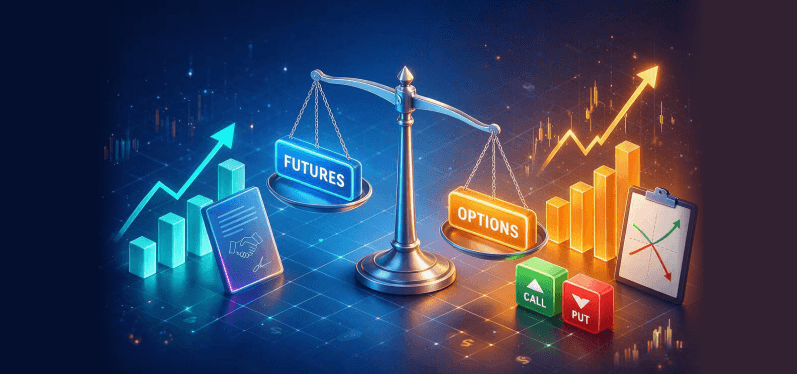
Futures trading involves buying or selling standardised contracts that derive their value from the expected future price of an underlying asset. These contracts require both parties to execute the transaction at a fixed price on a specified future date. Futures contracts provide exposure to equities, indices, and commodities without requiring immediate ownership of the underlying asset. Futures are mainly used for two purposes: hedging against price volatility and speculating on anticipated market movements. This article explains what futures trading is and how it works.
What are Futures Markets and Types of Futures
The futures market involves the trading of futures contracts, which are standardised agreements to trade an underlying asset at a fixed price on a specific future date. These contracts are traded on regulated exchanges and clearly define the contract size, quality, and settlement terms.
The 4 major types of futures include:
- Commodity Futures: They have physical assets like oil or grains, protecting producers from price drops as the underlying asset.
- Currency Futures: The exchange rates for future transactions determine their value, reducing forex risk in global trade.
- Interest Rate Futures: They are used to hedge against fluctuations in bond or money market rates.
- Stock Futures: They can involve both single stocks or indices and may help investors manage equity risk and market volatility.
How to Trade Futures?
Investors can trade futures on the National Stock Exchange (NSE) and the Bombay Stock Exchange (BSE). Here’s how to start trading.
- Understand the Futures Market: Futures are complex instruments, different from stocks or mutual funds. Beginners must learn how they work, including risks and costs, before trading.
- Assess Your Risk Appetite: Futures trading carries the risk of losses. Investors should evaluate how much capital they can afford to lose.
- Determine Your Trading Strategy: You can either trade based on your personal research or seek expert guidance to manage positions effectively.
- Practise on Demo Trading Accounts: Online demo accounts allow investors to practise trading futures without financial risk, gaining practical experience before you start trading.
- Open a Trading Account: A trading account with a broker is essential. Check the broker’s reputation, compare fees, and choose an account that suits your needs.
- Fulfil Margin Money Requirement: Futures contracts require margin deposits, usually a certain percentage of the contract size. Deposit it with the broker, who forwards it to the exchange. If margin requirements rise during the contract period, additional funds may be needed.
- Place Your Order: After adding funds to the trading account, investors can place buy or sell orders with their broker, specifying contract size, number of contracts, price, and expiry date.
- Settle the Contracts: Contracts must be settled either on expiry or earlier. Settlement may involve physical delivery, as in commodities, or cash settlement, common in equity index and interest rate futures.
How to Start Futures Trading with YES SECURITIES
The steps to start futures trading with YES SECURITIES are as follows:
Step 1: Open trading account and enable futures trading.
Step 2: Deposit the required margin funds.
Step 3: Select a futures contract based on assets, lot size, and expiry.
Step 4: Place a buy or sell order according to expected price movement.
Step 5: Monitor the daily margin balance through the Mark-to-Market (M2M) process.
Step 6: Close the position by taking an opposite order before expiry.
Step 7: Hold until expiry if desired, following cash or physical settlement rules.
Conclusion
Futures trading provides exposure to various assets through standardised contracts and settlement rules. A clear understanding of concepts such as margins, leverage, and settlement mechanisms is essential before entering the market. These fundamentals help individuals assess risks effectively and develop the discipline required for responsible trading. Futures trading may help individuals may help individuals understand market behaviour and enhance their learning experience.