Last Updated: 27th Jul, 2026
 4 Min read
 0
0
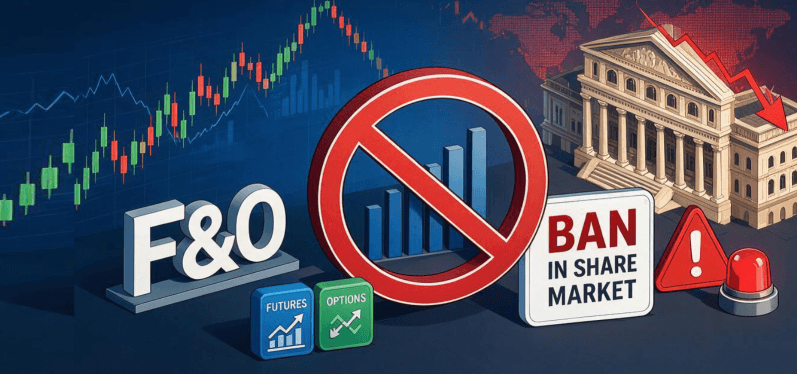
An F&O ban is basically a safeguard which is implemented by stock exchanges to maintain market stability. F&O ban means a trader cannot open new positions in futures and options contracts in the affected stock. It is the exchanges that impose a ban to protect the market participants from potential losses. The ban may last for one day or longer based on the conditions that led to the ban. Let’s explore in detail what is F&O ban in the stock market.
Why is an F&O Ban Imposed?
The main reason for an F&O ban is to restrict undue speculation and safeguard market integrity during volatile periods. The exchanges impose these limits for the following reasons:
- Prevent Market Manipulation: Unethical traders might try to manipulate the price of a stock through coordinated speculative movements. F&O bans often help diminish manipulative practices and ensure a fair-trading environment.
- Limit Speculation: If speculation on a stock is taken to extreme levels, the true market value of the stock might distort. It can lead to unfair outcomes for some participants.
- Safeguard Investor Interest: During periods of high volatility, retail investors might not be comfortable with sudden price swings. The ban serves as a protective mechanism to prevent excessive losses during such times.
Understanding Market-Wide Position Limit (MWPL)
The Market-Wide Position Limit (MWPL) is the basis of the F&O ban system and defines the total number of open contracts in the market. The MWPL is calculated to give a balance between market liquidity and risk management.
The MWPL's calculation considers two elements to derive it's limit. First, it takes 20% of the free-float shares held by non-promoters. The free float refers to the portion of the shares issued that are available to the public. Next, it examines the average daily trading volume in the cash segment from the previous month. The lower value between these two factors becomes the MWPL for that particular stock.
For example, if a company has 1,000 shares and 500 shares are held by non-promoters, then for the first component we take 20% of 500, which is 100 shares. Now, say the average daily trading volume for that stock is 80; then the MWPL would be 80 shares, as that is the lesser number than the first component. The calculation considers the availability of the stock and its recurring trading mechanism.
Penalties for Violating an F&O Ban
Traders who take new positions in a stock under an F&O ban face penalties of 1% of the increased position value, subject to a maximum of ₹5,000 per instance and an overall cap of ₹1 lakh. These penalties are designed to discourage violations and uphold market integrity.
Exception to an F&O Ban
The ban applies only to individual stocks and does not extend to index futures and options, since indexes represent broader market segments and are not restricted by MWPL limits.
Monitoring F&O Ban Alerts
Stock exchanges issue alerts when a stock’s open interest nears the MWPL threshold. For instance, the NSE provides alerts once open interest crosses 60% of MWPL, helping traders adjust positions in time to avoid penalties or losses.
Regularly tracking these alerts and monitoring trading platforms ensures traders remain informed about MWPL changes and F&O ban status, enabling better risk management and compliance.
Impact of an F&O Ban on Share Prices and Market
The impact of F&O bans on market dynamics may be categorised into several areas:
- Reduced Trading Volume: The inability to take new positions often leads to decreased trading activity and liquidity in the derivatives segment.
- Price Volatility Impact: While the ban generally reduces price volatility, the actual effect depends on the reason behind the restriction.
- Market Sentiment Influence: If the ban results from negative news about the company, the stock price might experience sharp movements as existing position holders exit.
- Stability in Strong Fundamentals: When the ban is imposed due to excessive speculation, but the company's fundamentals remain strong, prices may stabilise or even increase slightly.
- Spillover Effects: The reduced derivatives activity might indirectly affect cash segment trading, potentially influencing the stock's overall price discovery mechanism.
Conclusion
F&O bans serve as important safeguards that protect market integrity while preventing excessive speculation. By staying informed about ban alerts, monitoring open interest levels, and understanding the underlying mechanics, traders may manage their risks more effectively and make informed decisions. Moreover, respecting these restrictions not only helps avoid penalties but also contributes to maintaining a stable trading environment for all market participants.