Last Updated: 9th Oct, 2026
 9 Min read
 0
0
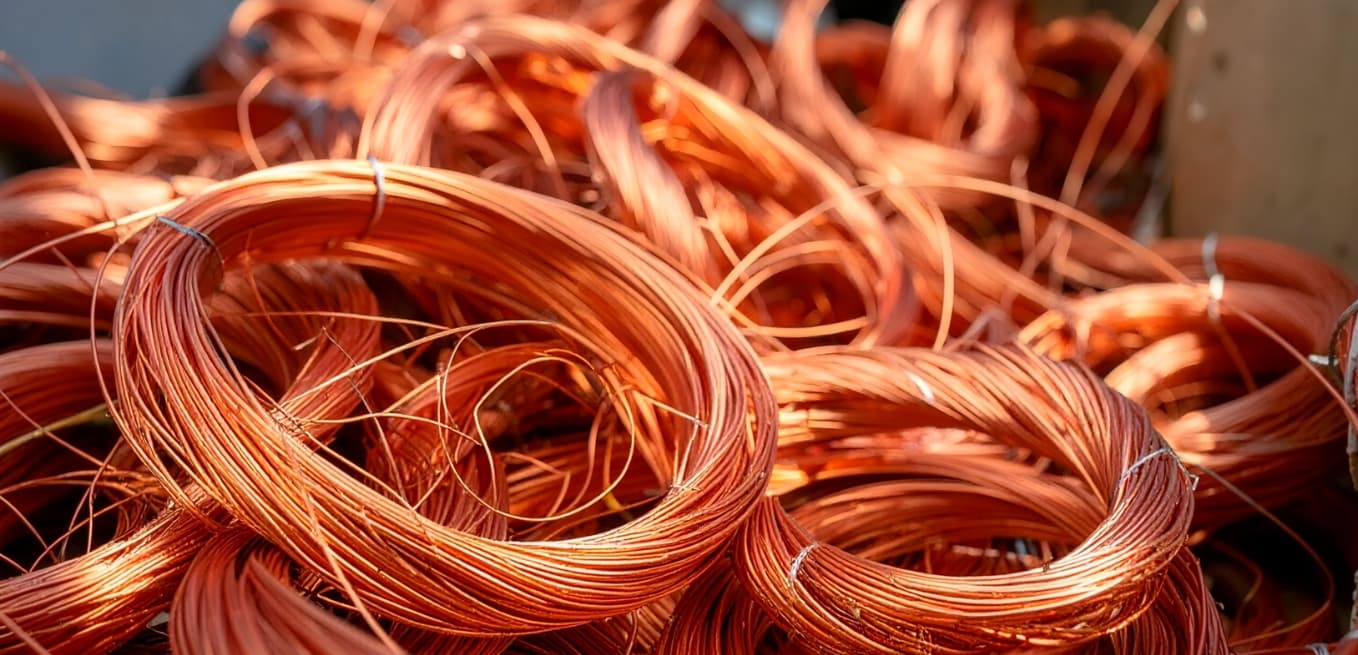
Copper doesn’t get the same attention as gold or crude oil, even though the modern economy cannot run without it. It is inside the wiring of your home, the motor of your fan, the data centre powering your favourite AI tool, and the solar panel on your neighbour's rooftop. As the world electrifies faster than ever before, copper has become one of the most closely watched metals in global markets.
What is Copper?
Copper is a soft, malleable, and ductile reddish-brown metal known for its very high electrical and thermal conductivity and its resistance to corrosion. It is one of the few metals that can occur in nature in a directly usable form. This is one reason why human civilisations have been working with it for thousands of years.
Copper's importance comes down to one simple fact: nothing conducts electricity as efficiently and inexpensively as copper. This conductivity, combined with copper's durability and recyclability, makes it irreplaceable in most electrical and industrial applications. Because of this, several major economies such as the United States, Japan, Australia, China and the European Union, have classified copper as a critical mineral.
How Does Copper Power the Modern Economy?
Copper has been described as the "connective artery" linking physical machinery, digital intelligence, mobility, infrastructure and communication systems. This role goes back a long way. Thomas Edison's company laid roughly 80,000 feet of copper wiring under the streets of Lower Manhattan in 1882 to light up one square mile of the city. This marked copper's debut as the metal of electrification.
More than a century later, the story has only grown bigger. Global electricity demand is projected to rise by almost 50% by 2040, and copper sits at the centre of almost every part of that growth- from grids and data centres to electric vehicles and renewable power.
What Are the Major Uses of Copper?
Globally, copper's uses in 2024 broke down roughly as follows:
- Building construction 26%
- Consumer and general products (cooling and electronics) 23%
- Infrastructure (power and telecom) 17%
- Transportation 13%
- Industrial equipment accounted for 12%
- Other uses 9%
Global Copper Production and Supply
On the mining side, the world produced around 23 million tonnes of mined copper in 2024, with global reserves estimated at about 1 billion tonnes. Chile remains the world's largest producer, accounting for roughly 23% of global mined output, followed by the Democratic Republic of Congo (14%) and Peru (11%).
On the refining side, global refined copper production reached 27.5 million tonnes in 2024, up from 26.5 million tonnes the year before.
Keeping this supply growing is not easy and several analysts now flag a potential copper supply shortfall in the years ahead:
- Long mine development times: Mines that began production between 2020 and 2023 took an average of 17.9 years from discovery to first output. For mines that started 15 years earlier, it took around 12.7 years. Much of this time is spent on exploration, permitting and financing rather than actual construction.
- Fewer major discoveries: New large copper deposits are becoming harder to find. Only four major discoveries were made in the five years leading up to 2023. New discoveries added 4.2 million metric tons, whereas the remaining 43 million metric tons were sourced from the discoveries of 1990. Companies are increasingly focused on expanding existing mines rather than exploring for new ones.
- Declining ore grades: As high-grade, easy-to-access deposits are used up, mining companies are forced to process lower-grade ore. This means moving and processing more material to get the same amount of copper. This raises costs and environmental impact over time.
- Limits of recycling: While copper recycling helps, improvements in collection and processing could supply at most about a third of total global demand by 2040, leaving primary mining as the backbone of supply.
Copper Demand and the Energy Transition
S&P Global projects global copper demand rising from roughly 28 million metric tons in 2025 to 42 million metric tons by 2040, a 50% increase. This growth is driven by four broad factors: everyday economic activity such as construction and appliances, the clean energy transition, the rapid build-out of AI and data centres and rising global defence spending.
The energy transition specifically is a major swing factor. The International Energy Agency's climate-aligned scenarios show that mineral demand for clean energy technologies could double by 2040 depending on how fast the world decarbonises. Copper is essential to electricity and its related technologies.
Financing is scaling up to match this shift. According to Bloomberg NEF, unlocking sufficient investment to triple global renewable energy capacity by 2030 will require substantial new capital across the power sector, indirectly driving further copper demand.
What Factors Affect Copper Prices
Copper has long been nicknamed "Dr. Copper" because its price is often treated as a barometer of global economic health. Demand for copper tends to rise when construction, manufacturing and clean technology adoption are strong, and to weaken during slowdowns.
The average monthly copper price fell to a low of $4,472 per tonne in 2016 and later surged to a peak of $10,231 per tonne in March 2022. In 2024, the average price stayed relatively high at around $9,142 per tonne.
Several structural factors influence where prices go from here:
- Supply-side constraints: Long mine development timelines, few major new discoveries, and declining ore grades make it harder to bring new supply quickly.
- Demand shocks: Sudden surges in demand from specific sectors, such as AI-driven data centre construction, can create short-term price volatility.
- Domestic price references: In India, the three-month average London Metal Exchange (LME) copper price stood at around $9,724 per tonne in October 2024. This benchmark directly affects the cost of copper-intensive projects and imports in the country.
India's Copper Market
India currently (2024) imports over 90% of its copper concentrate requirements. Hindustan Copper Limited (HCL) remains the country's only copper mining company, with a mining capacity of around 4 million tonnes. However, production has stayed largely flat in recent years due to regulatory and operational delays at some mines.
On the demand side, India's copper consumption has been accelerating. According to the International Copper Association India, the country's copper demand rose 9.3% year-on-year to 1,878 kilo tonnes in FY 2025. Building construction and infrastructure were the strongest growth drivers.
India's Ministry of Mines projects that domestic copper demand will climb to 3-3.3 million tonnes by 2030 and 8.9-9.8 million tonnes by 2047. This growth is expected to track India's GDP growth closely, supported by renewable energy targets and rising electric vehicle adoption.
Copper is used extensively in defence equipment, the space programme, railways, power cables, and telecommunication cables.
Role of Copper Recycling
Copper can be recycled repeatedly without losing its chemical or physical properties. Globally, around 32% of copper consumption in 2023 came from recycled sources.
That said, recycling should be seen as a complement to mining rather than a replacement for it. Even with very aggressive improvements in collection and processing infrastructure, secondary supply could provide at most around a third of total copper demand by 2040, leaving a gap that only new mining investment can close.
Copper Investment: Opportunities and Risks
Opportunities
The case for copper rests largely on a demand story. Unlike past cycles that were driven in isolation by one sector or one country, today’s demand is being pushed up simultaneously by data centres’ construction, EV adoption, renewable energy, grid expansion, and increased defence spending. Demand is forecasted to grow by 50% from 28 million metric tons to 42 million metric tons.
India adds a further layer of opportunity with demand growing at 9.3% in FY 2025. India’s copper sector has a long runway for expansion as infrastructure spending, renewable energy targets and electric mobility goals progress.
Looking at it from the supply side, long development times of new mines and fewer major new discoveries, making the growth in supply very slow compared to the demand. This means prices increase for medium to long term assets, benefiting existing producers.
Risks
Copper has seen price volatility in the past. Average copper prices moved from a decade low of US $4,472 (2016) to US $10,231 (2022) per tonne in six years. Because its consumption is closely tied to infrastructure and construction activity, it tends to weaken during economic slowdowns.
Supply is geographically concentrated in a few countries making it a trade policy risk and a geopolitical risk. The market is then vulnerable to disruptions, economic restrictions, and jurisdiction-based restrictions.
Declining ore grades means successful mining projects also see rising costs over time, since more rock must be moved to extract the same amount of copper. Recycling, in itself, would be unable to meet the entire rising demand, although it can help narrow the gap.
How is Copper Traded?
Copper prices are largely set on international commodity exchanges such as the London Metal Exchange. In the US, Copper Futures trade on COMEX, part of CME Group.
In India, Copper Futures trade on the Multi-Commodity Exchange of India (MCX).
How to Invest in Copper?
Common routes people use to get exposure to copper include
- Buying shares of listed copper mining and processing companies
- Investing in copper focused mutual funds ETFs that track copper or broader metals indices
- Trading copper futures on commodity exchanges, where prices are benchmarked to references like the London Metal Exchange
Conclusion
Copper's story over the next two decades looks set to be shaped by a genuine tension: demand is rising on the back of electrification, AI infrastructure, electric vehicles and renewable energy, while supply faces constraints from long mine development times, fewer major discoveries, and declining ore grades. Recycling will help narrow this gap but cannot close it on its own.
For India, this is both a challenge and an opportunity. With demand projected to grow several-fold by 2047, India's copper sector has significant room to expand; if domestic mining, refining and recycling capacity keep pace with the country's rising appetite for the metal.
References
https://natural-resources.canada.ca/minerals-mining/mining-data-statistics-analysis/minerals-metals-facts/copper-facts
https://www.spglobal.com/market-intelligence/en/news-insights/research/average-lead-time-almost-18-years-for-mines-started-in-2020-23
https://www.spglobal.com/market-intelligence/en/news-insights/research/major-copper-discoveries
https://doi.org/10.1016/j.resconrec.2013.10.005
https://www.spglobal.com/en/research-insights/special-reports/copper-in-the-age-of-ai
https://www.iea.org/reports/the-role-of-critical-minerals-in-clean-energy-transitions
https://assets.bbhub.io/professional/sites/24/Unlocking-Investment-to-Triple-Renewables-by-2030.pdf
https://mines.gov.in/admin/storage/ckeditor/Final_Copper_Vision_Document_20_1751560229.pdf
https://www.business-standard.com/industry/news/india-s-copper-demand-rises-by-9-3-to-1-878-kilo-tonnes-in-fy25-report-125102900951_1.html
https://ibm.gov.in/writereaddata/files/1683196066645388a2cdf30Copper_2021.pdf
https://press.spglobal.com/2026-01-08-Substantial-Shortfall-in-Copper-Supply-Widens-as-the-Race-for-AI-and-Growing-Defense-Spending-Add-to-Accelerating-Demand,-New-S-P-Global-Study-Finds
https://www.jpmorgan.com/insights/global-research/commodities/copper-outlook