


 Last Updated: 19th Nov, 2026
 5 Min read
 0

For most of 2026, at least until September-end, one part of the Indian market remained surprisingly weak — the Nifty Top 10 Equal Weight Index.
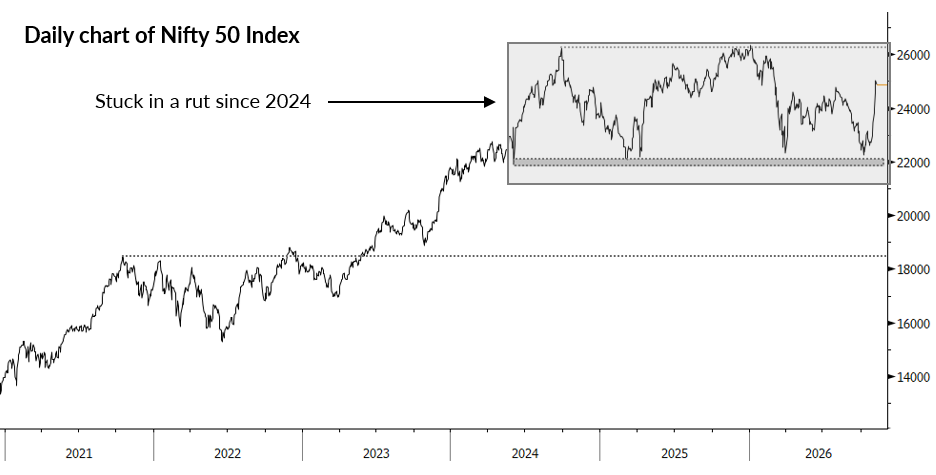
And this was happening in a market that, from a larger perspective, has been stuck in a rut since 2024. The headline index wasn't really going anywhere, but beneath the surface, there was plenty of action. Leadership was changing, money was moving around and investors were finding opportunities away from the traditional large-cap space.
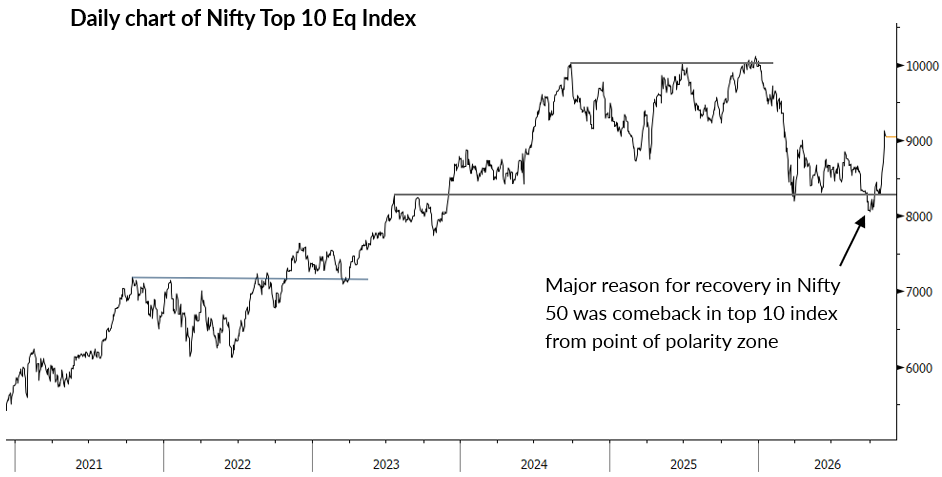
What caught my attention, however, was which stocks were being left behind.
We weren't talking about random names or businesses struggling for relevance in that period. We were talking about some of India's most successful companies — RIL, IT Names, HDFC Bank, SBI and several other heavyweight names.
So, I started looking at this group a little differently. The Nifty is, after all, just 50 stocks. I have always believed that the Nifty 50 is nothing more than a basket of 50 individual stocks. That sounds obvious, but it is sometimes easy to forget when we talk about the index as one entity.
These Top 10 names (HDFC Bank, ICICI Bank, RIL, Bharti Airtel, LT, Infosys, SBI, Axis Bank, Kotak Bank & Bajaj Finance) together command roughly 50% weight of Nifty 50. So, for me, tracking what happens to this group isn't just about following ten stocks. It is a way of understanding the behaviour of the index itself — and, perhaps more importantly, where the next phase of market leadership could come from.
The interesting part was that these stocks (Top 10) had effectively lost leadership.
How Market Leadership Shifted Towards Midcaps and Smallcaps
By April 2026, the baton had clearly moved towards the broader market - Smallcaps, midcaps and even microcaps started taking charge. Portfolios were doing well, participation was broadening and, frankly, for a while, Nifty 50 didn't really matter. You could blame FIIs. You could blame crude. You could blame geopolitical noise or any number of external factors.
But perhaps the simpler explanation was this: investors had found better opportunities elsewhere. And that, in my view, is what healthy market rotation looks like.
Money doesn't necessarily leave the market. It simply moves to where investors see better opportunities.
Are the Big Boys Making a Comeback?
What happened next is where the story became more interesting for me.
Instead of looking at these stocks individually, I started looking at the Nifty Top 10 Equal Weight Index relative to Nifty 50. The ratio had been under pressure for much of the year. But rather than continuing to deteriorate, it started showing signs of stability around its July low. Nothing spectacular at first. Just a base. But sometimes, that is all you need to see.
The ratio holding above its July low suggested to me that the underperformance of these large-cap leaders was perhaps losing momentum. And eventually, that base translated into a sharp move higher towards the end of October and into November.
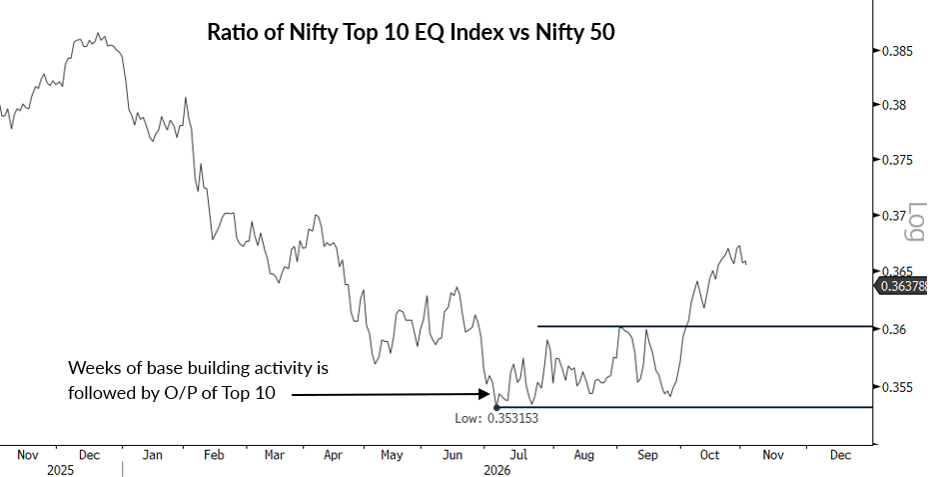
Suddenly, the story started changing. The big boys were coming back.
And this could represent another important transition in the market — one where the Top 10 Nifty stocks begin to outperform the broader mid-, small- and micro-cap universe after months of relative weakness.
Could Nifty 50 Heavyweights Become the Next Market Leaders?
Look at what is happening beneath the index. This is where I find market analysis particularly interesting. When you see HDFC Bank, RIL and ICICI Bank all rallying around 10% in a single week, it is difficult to dismiss it as just another short-term move in individual stocks.
When some of the biggest names start moving together, something broader could be happening. It is almost like a rising tide lifting all boats. And perhaps that explains why the Nifty 50 has suddenly found its way back above the 24,500 zone.
For nearly ten months, these large-cap names were arguably one of the biggest reasons why the Nifty struggled to make meaningful progress. Now, ironically, the same group could become one of the reasons why the index moves higher.
I don't think this means that midcaps, smallcaps or microcaps suddenly becomes unattractive. What I find more interesting is the change in leadership.
For much of 2026, the market rewarded investors for looking beyond the Nifty. The broader market took the baton while the traditional heavyweights struggled. Now, the baton is changing hands again.
And if the relative strength of the Nifty Top 10 continues to improve, these stocks could potentially become the next set of leaders.
And after almost ten months of being the problem, the big boys may finally be becoming part of the solution. Though, post 8.4% rally last week, the gap between price and its short-term average has widened significantly, while our customized Nifty 50 breadth has also moved to an extreme zone. Together, these readings suggest that the market is stretched and could witness a time-wise correction in the near term. But I believe in ignoring the noise and looking at the bigger picture and focusing on leaders.
Brief Profile about the Author:
Pritesh Mehta is a seasoned Indian equity research analyst with over 20 years of experience, currently advising institutional buy-side clients on market trends, sectoral leadership and high-conviction positional opportunities. He previously spent 13 years with the IIFL Group as Lead Technical Analyst.
His expertise spans relative strength, inter-market dynamics, sectoral rotation, Gann studies, customised indices and noiseless charts, combining these tools within a top-down framework to identify emerging market trends and medium-to-long-term investment opportunities.
A regular contributor to The Economic Times and Moneycontrol, Pritesh has also spent over a decade on business television, including appearances on CNBC-TV18 and other leading financial news platforms, sharing insights on market behavior, structure and trends.


